BlogSep 28, 2026
Solutions
© SOLO FINANCE INC. 2026
SOLO is the single shared customer record maintained by the industry: one collaborative profile that makes completed verification work portable across institutions, so onboarding stops restarting from zero every time a customer applies somewhere new.
For optimizing conversion and unit economics.
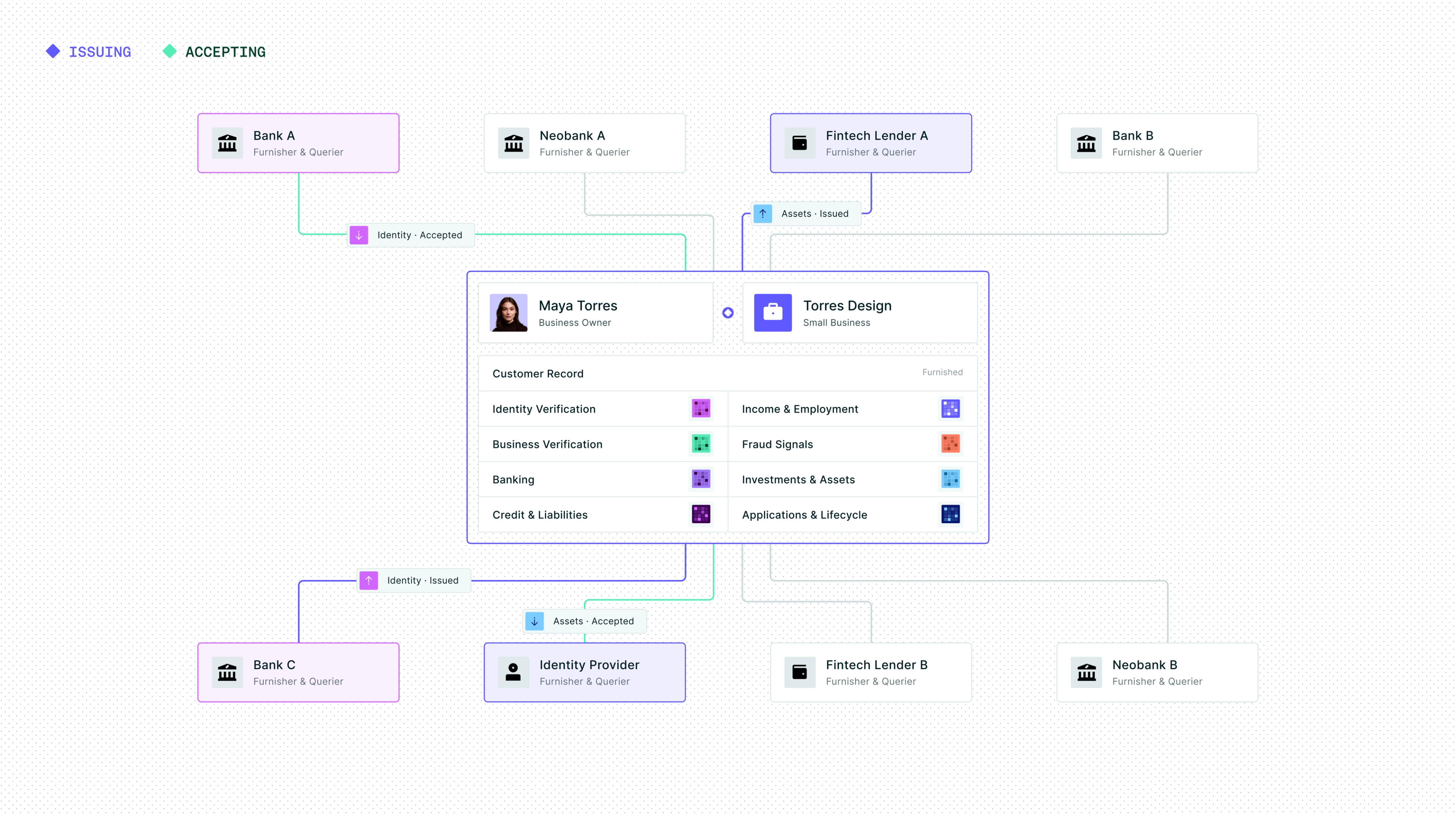
SOLO facilitates a single shared customer record per individual, built and maintained by 240+ banks and fintechs.
The record holds 270+ data attributes across 8 data schemas. Each attribute carries provenance establishing how it was collected and by which institution, and evidence, establishing how it was verified.
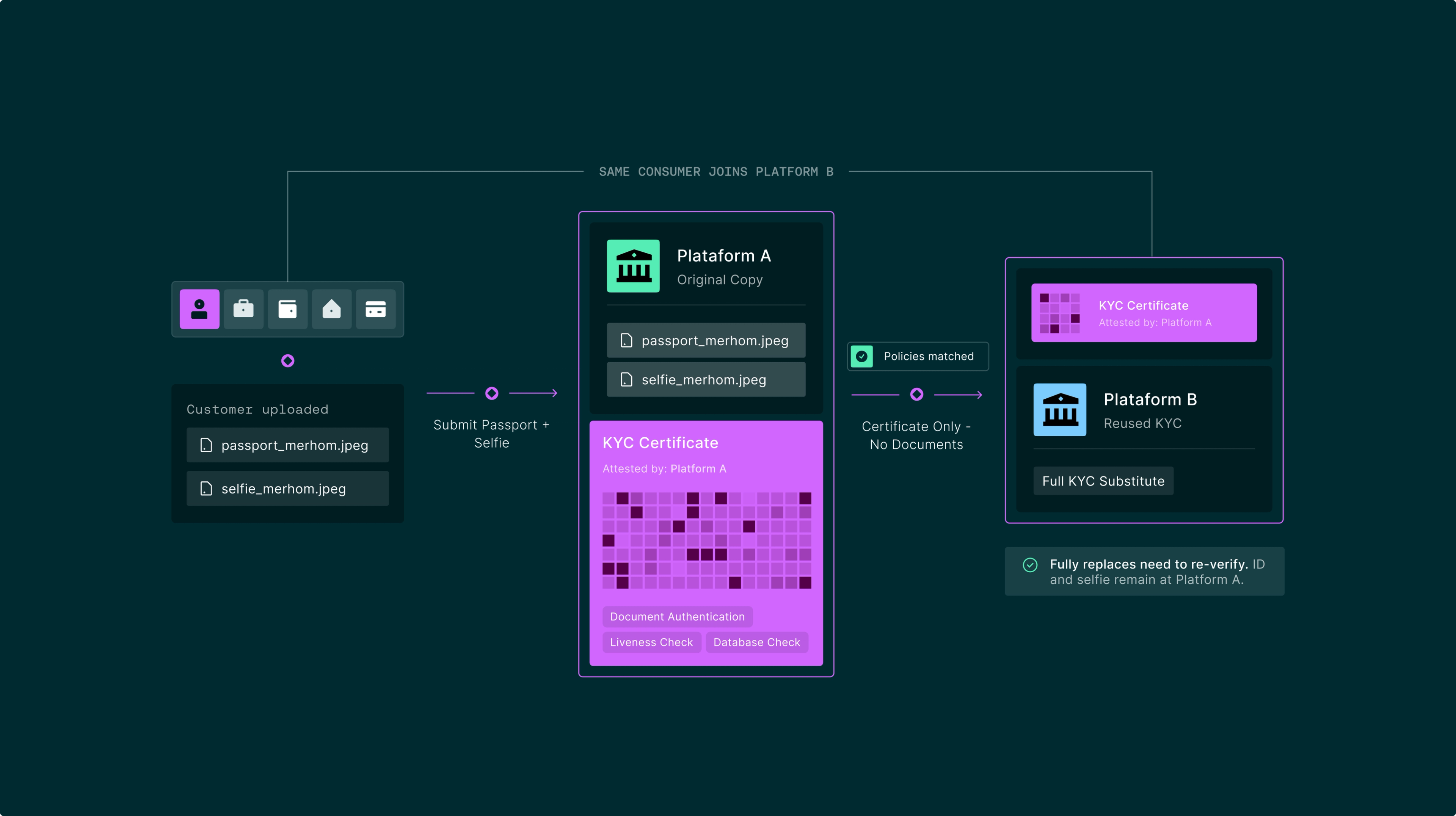
A certificate is not a copy of a customer's file passed between parties. It's a bank or fintech’s finished work itself, packaged as an interoperable reliance record that enables a fintech or regulated institution to skip that step in their process.
Certificates include KYC verification, KYB verification, and fraud screening outcomes. They are queried at the top of a workflow to remove or partially skip steps downstream and in customer applications.
A fintech or bank’s Querying Policy acts as a filter for all data and certificates that are returned from the network.
Before querying the network for data and certificates that exist, SOLO first reads an institution's requirements for what data is needed and how it should be verified. This is configured by SOLO into a policy. It defines what checks must have been performed, by what method, how recently, and at which step.
Data furnished to the network must also be defined by a mirrored furnishing policy, attested to by the provider, and audited and graded by SOLO before it becomes available for querying.
These configurations allow SOLO to match queries to data furnished by peers without blind trust, and without forcing standardization across the industry to enable interoperability. When previously furnished verification work meets the standards of a querying policy, that step can fully be removed from the workflow and replaced by the certificate returned by SOLO.
If a policy cannot be fully fulfilled by what already exists, either because the verification artifacts fail to align, conflicting data is found on file, or data has become outdated, a resolution is triggered.
Depending on the workflow and need, resolutions may be configured to proceed with third party or public database checks. They may also be customer facing, allowing for the customer to be an active participant over their record.
For the customer, onboarding shrinks. Fields arrive pre-filled from the record when they consent to share what exists.
Compliance steps previously completed by another provider, like ID document upload, biometric verification, business entity verification, beneficial ownership & control person checks, and more can be fully removed from the application.
Where the customer does appear in the flow, the interaction is to resolve what’s still needed: correcting information on file that conflicts across sources, and supplying whatever the network could not.
Whatever an institution collects to close a gap can be published back to the network as a certificate — their data asset that earns when other institutions reuse it.
Under conventional dynamics, verification is a cost incurred at the moment of onboarding that must be absorbed throughout the lifecycle of the customer.
Under SOLO’s economic model, furnishers are compensated for what they collect, verify, and publish. Compliance work is credentialed and rewarded for reuse. The economics of customer acquisition shift from net cost, to potential net new revenue regardless of the outcome of the relationship.
For banks and fintechs participating in the network, SOLO scales conversion and unit economics for customer intake.
Verification spend falls because steps completed elsewhere are removed rather than repeated.
Conversion rises because there is less application left to abandon.
And what the bank or fintech does still collect earns when peers reuse the work, so acquisition cost is recovered whether or not the customer converts.
For consumers and small businesses, SOLO ends the ‘re-set’ that occurs with each new relationship.
Customers consent to what's shared, correct what's wrong on their record, and supply only what the network doesn't already hold.
High friction verification work like document upload and biometrics is performed once, not once per institution.
For regulators, SOLO produces a stronger audit trail with network wide accountability and interoperable reliance artifacts.
Every attribute carries provenance and evidence.
Every verification is backed by an attested, graded certificate naming the institution that performed the work, the method used, and when.
Reliance becomes documented and examinable rather than assumed.