BlogSep 28, 2026
Solutions
© SOLO FINANCE INC. 2026
Results from SOLO's Conversion Scorecard, ranking conversion across top business banking fintechs.
Benchmark and optimize customer conversion.
We scored twelve of the biggest names in fintech on their business banking application: Slash, Flex, Relay, Rho, Lili, Mercury, Brex, Stripe, Square, Ramp, Truist, and Novo.
We then analyzed conversion through four weighted categories:
In addition to the original cohort of seven, the five we added this week were: Lili, Relay, Novo, Rho, and Truist.
Both ends of the table moved.
Lili takes the category with an 87.2, the highest score we have recorded in business banking. Truist takes last place at 22.3, the lowest score we have recorded in any category to date — on an application that never completed at all.
The best scored an 87. The worst scored a 22 with a wide spread in between. Their scores reveal that fintech, despite its many advances as an industry, has yet to solve for compliance and conversion simultaneously, viewing them as competing interests rather than potentially complementary to their top of funnel motion.
SOLO’s team opens accounts with their real business records, start to finish, for an unbiased scoring process.
Each application was timed continuously from start to finish, including any lag time in between document requests from multiple parties to reflect the true experience of a small business owner applying for a financial product in the midst of day to day activities.
Upon conclusion of the application, the experience was scored from start to final decision with the Conversion Scorecard Rubric. The Conversion Scorecard was developed as a diagnostic tool for fintech operators to benchmark their customer conversion compared to industry best practices.
SOLO scored the following fintechs as the first cohort in the Business Banking Category:
| Fintech | Score | Date Scored | |
|---|---|---|---|
| Lili | 87.2% | NEW | 09.10.26 |
| Relay | 81.2% | NEW | 09.10.26 |
| Square | 81.2% | 08.13.26 | |
| Flex | 76.4% | 08.13.26 | |
| Novo | 76.0 | NEW | 09.10.26 |
| Rho | 70.8% | NEW | 09.10.26 |
| Stripe |
The leanest application, purely defined by number of data fields, still belongs to Square at twenty separate data points. The median across all twelve applications is 41.5 fields.
The heaviest application by data fields remains Slash: fifty-six fields across fifteen screens, with eight document uploads, two devices, and a required trip to a government registry to buy a certificate and upload it back into the application.
The lowest-scoring is now Truist, which asked for thirty-one manually entered fields across ten screens and then failed before any decision was rendered.
Lili posts the strongest application experience in the business banking category by a significant margin.
Six minutes and forty-seven seconds from first screen to fully funded account, The application itself was completed in less than five minutes. The user received an instant decision, with the account active and a digital debit card usable immediately. Twenty-nine fields total — but multiple of those were confirmations of data Lili had already pre-filled from earlier answers: the operational address, the business ownership percentage and personal information, and the ownership percentage.
No document uploads of any kind. No required account connections. The optional funding connection worked cleanly through a third-party integration and never blocked completion. Perfect on Application Time. Perfect on Decision Speed. Clear reasoning and next steps stated at approval.
So why isn't it a 100%?
Two things. The first is bulk. Twenty-nine fields, though fewer than most in the category, and thirteen screens still puts both data entry volume sub-metrics at the rubric floor. Nineteen of those fields could arrive pre-filled from records that already exist, which would take this application under three minutes.
The second is what wasn't asked. From the applicant's seat, Lili required no ID document upload and no biometric check on the applicant, and did not verify the operating address through a document-based check like a utility bill or a lease agreement. Rationale for sensitive asks leaned on a catch-all "best practices" phrase rather than a concrete explanation of use.
That does not mean those steps never happen. They may be delayed until later in the customer lifecycle — a pattern we see often, and one that is especially common where a regulated sponsor bank sits behind the program. The logic is straightforward: move the applicant to a funded dashboard before the friction arrives, and drop-off goes down.
The cost is that the same friction reappears later, after the money has already been spent to open the account, and it becomes a reason for account closure instead of a reason for abandonment.
That tradeoff no longer has to exist.
Square held this category through cohort one and still runs the leanest flow we have scored: twenty fields, eight screens, under five minutes, zero documents, zero required account connections, zero follow-ups. Perfect on Application Time. Perfect on Decision Speed.
It also remembered us within the application. We did not have to rekey name, email, and address three separate times in one session.
It is also the clearest example of the pattern that now sits at the top of the whole table, including at number one.
From the user's side, there was no KYC. Square is likely working with a third-party vendor on the back end even if we cannot see that from the applicant's seat. That would not be a substitute for the verification artifacts needed to assemble a full CIP record when a regulator requests it. Square's current process poses a risk that a sponsor bank partner would not be able to afford in a regulatory examination.
Square's application highlights what is currently a flaw across the industry. Friction related to CIP requirements isn't solved. It got skipped.
The diligence steps aren't satisfied somewhere else in the flow. As far as we can see from an applicant's perspective, they are simply missing, with no insight into what information Square may be assessing without their knowledge to determine eligibility.
Although this application may provide a superficially pleasant experience for the user in the first five minutes of their relationship with Square, it creates a risk to both the customer and Square's partners. The customer may be required to fulfill the KYC and KYB friction later at the risk of having their account closed, or may be hindered from scaling their relationship with the platform until they complete additional verification requests. Square's partners would not have the verification artifacts needed to trust Square's work without requiring the customer to redo KYC and KYB themselves at the point of accepting a relationship. That harms both the success rate of potential referrals and Square's own customer relationships.
Lili and Square arrive at the top of this ranking from the same direction. The diligence friction was not solved; it was deferred or skipped. That is a conversion win today and an exposure for their bank partners tomorrow.
If Lili or Square were to do two things — pre-fill not just what the user supplied once in this session but everything already collected on that customer elsewhere, and fulfill the delayed CIP and CDD asks with a KYC certificate or KYB certificate that actually removes those steps from the application experience — they would be more dominant on conversion than they already are, with a stronger compliance record rather than a weaker one.
Truist set a new record for the lowest Conversion Scorecard score in any category we have scored.
Their business checking application fully timed out. A service-unavailable error appeared and never cleared. This came after the applicant had supplied nearly every piece of information requested across ten screens and thirty-one manually entered fields, with no pre-fill of any kind, and had apparently reached a pending-decision state.
He was left with no way to answer any of the obvious questions. Was he ineligible, and if so, why? Was this a glitch? What happens now to the PII and business information he had just handed over?
There were no communications of any kind afterward. No status, no follow-up email, and no login issued to check. As of this review, the application's fate is unknown.
Because this was a business account and not a consumer one, Truist had no adverse action notice obligation if ineligibility triggered the failure. It still costs them points in every category, including outcome transparency, because the applicant had no way to advocate for himself toward the outcome he wanted. A customer who may simply be ineligible today can be told why, and told what would change it. Instead the relationship is gone — and it was a relationship that could have been grown into a high-value commercial account.
Along the way the flow also prompted the applicant repeatedly to log into a Truist account he did not have, and re-asked address, phone, SSN, and other personal details across screens. Twenty-eight of the forty asks could have arrived pre-filled from records that already existed.
The objective of the scorecard is to help operators diagnose, benchmark, and optimize their own conversion. Cumulatively, these scores become a well balanced frame of reference for what conversion looks like today vs. with reliance, the ability to fully accept another party’s work without repeating it.
SOLO is working with 240+ fintech programs and sponsor banks to operationalize reliance across the fintech and banking ecosystem. The Scorecard was designed specifically for those programs identifying and measuring the impact of reusable verification work on their customer experience and top of funnel metrics.
According to our study of this cohort, a major conversion gap exists today across fintechs regardless of their market maturity and size.
Every one of these fintechs treated the user like a business with no history.
In the course of this review alone, our record was verified by six new fintechs and their sponsor banks. The record existed before the first application. We rebuilt it six times.
However, the customer still starts from a blank form, regardless of how many financial providers have already done the work of verifying their identity and business.
Of the new fintech's ranked, Rho, Relay, and Novo all asked for document-based KYC and CDD: an ID document upload, a selfie check, and an articles of incorporation upload.
If any of these three implemented a KYC or KYB credential that let the customer reuse the verification work and record that they have already established with another provider, they would move up the rankings immediately.
Our work at SOLO is focused on making the customer’s record work for them where it’s needed: at account opening, onboarding, and throughout the servicing of their relationship with a fintech or bank.
By leveraging the data and the work that has already exists on the customer - including document capture and review, biometrics checks, and address verifications - making it auditable, and surfacing it in the customer experience when it meets new providers standards and policy, SOLO helps fintechs provide an experience that optimizes conversion while meeting higher standards for CIP compliance.
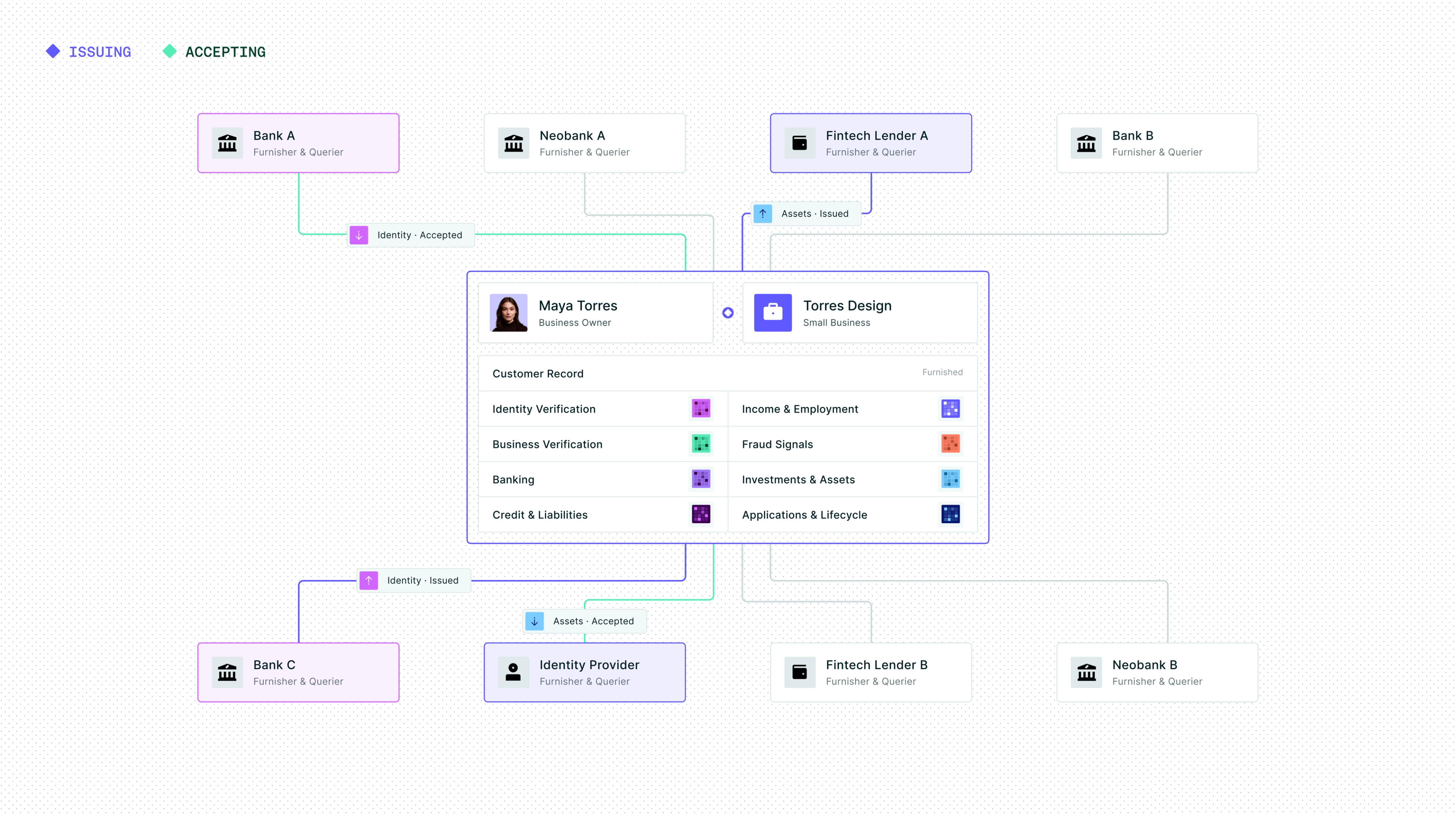
Partner Pre-Fill activates the network you already have. Someone your customer already trusts — who already has the articles of incorporation, already has the EIN letter, already has the financials, already knows exactly who the beneficial owners are — hands them to you. And then you ask that business owner to go find all of it again themselves.
In this case, SOLO builds a customer-gated catalogue of the records your referral partner holds — an index of what actually exists across their systems. When the referred customer applies, they enter a few identifying fields, and the rest gets pre-filled from your partner with their permission. Based on what we saw in this group, that's 40+ fields off a median application.
Partner Pre-Fill is available to any fintech today, regardless of the sponsor bank’s formal participation in the SOLO network.
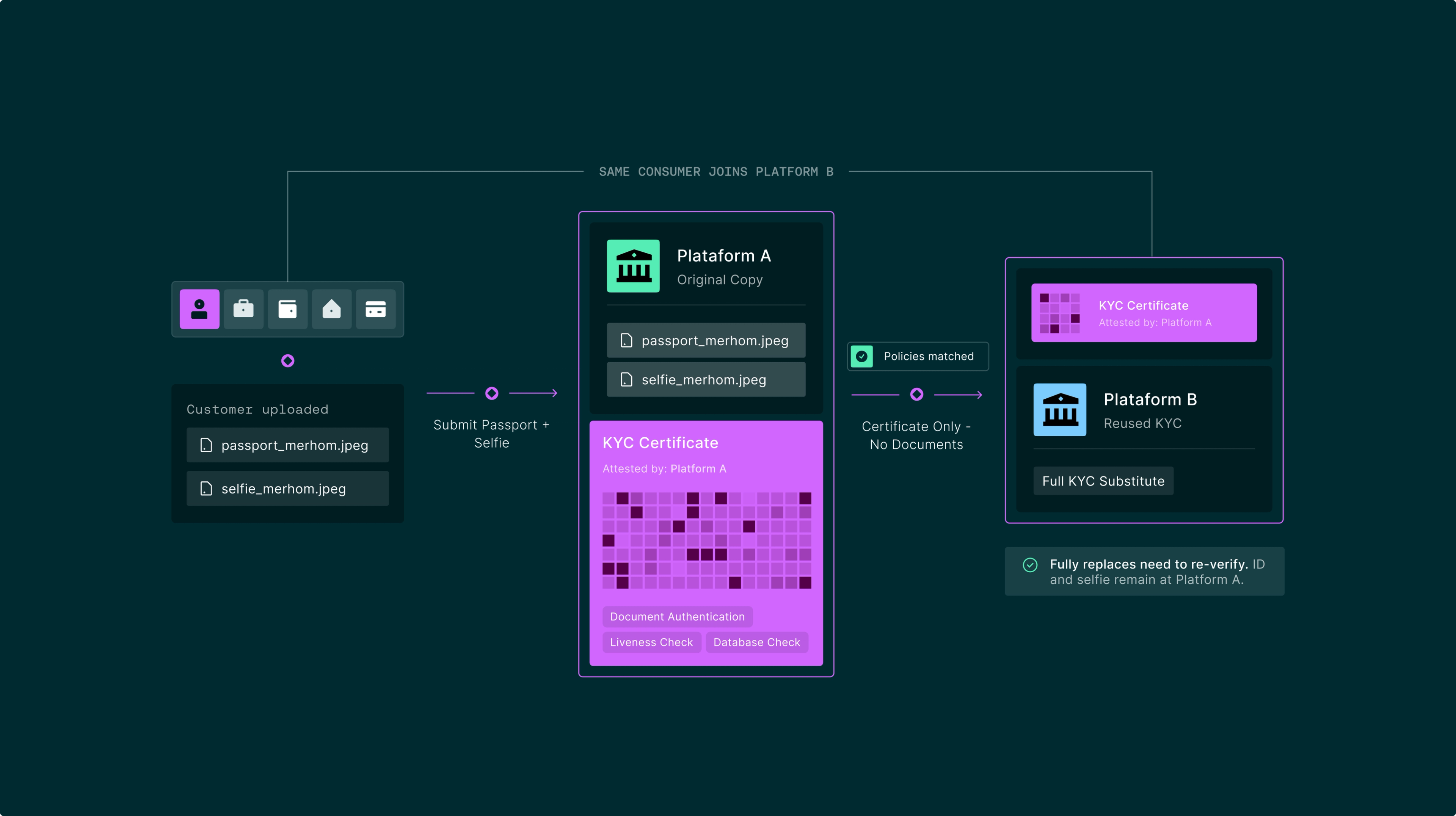
KYB and KYC Certificates activate our reliance network. Certificates are bank-attested sets of reliance artifacts that let you skip KYB or KYC steps another network member already completed, when their bank attests to it and it matches your policy.
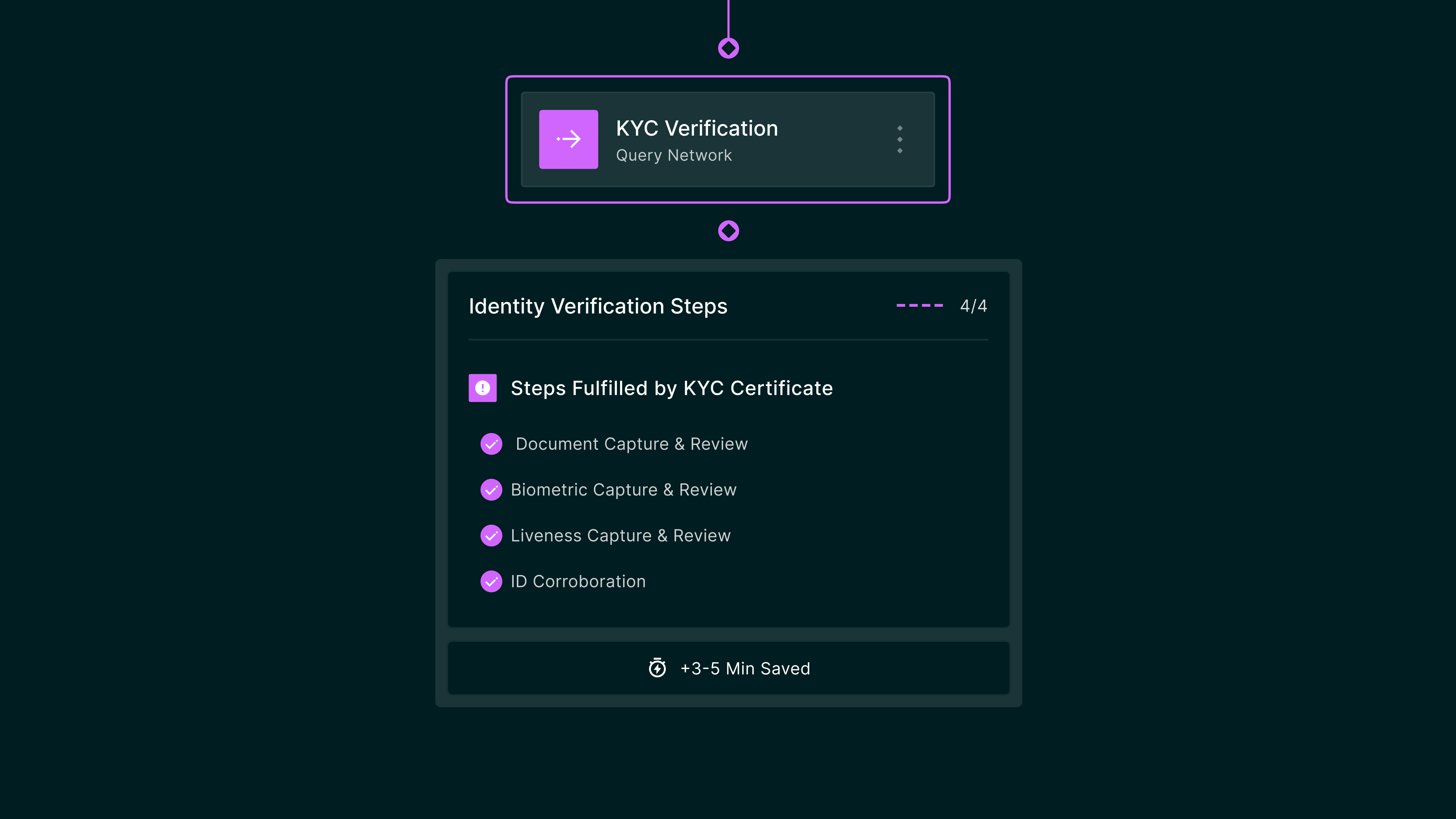
The customer gives you a few identifying fields, consents to share what exists, and the previously completed verification steps disappear from their application path — document capture, biometrics, the selfie video check. All removed. On the back end, the fintech and their sponsor bank receive the examiner-ready artifacts your bank needs to trust the work that was already performed.
The experience is similar to a TSA PreCheck line. The customer breezes through because the work was already done to the fintech and bank’s standard, not because it was waived.
The provider protects every single CIP step, but the customer feels like they're skipping the line: with 40+ possible fields and 8-10 steps removed from their application.
Due to recently released guidance from FinCEN, certificates are now eligible to be used by any fintech - not just those whose sponsor banks are members in the SOLO network.
Interested fintechs and banks may meet with SOLO to determine eligibility for certificate furnishing and use.
Every fintech in this cohort will receive their full scorecard: the category breakdown, the field-level count, and the specific steps that could be removed and data that could be pre-filled from network records that already exist.
If you weren't in this cohort and would like a diagnostic of your own application process, request your scorecard below.
| 70.8% |
| 08.13.26 |
| Mercury | 70.0% | 08.13.26 |
| Brex | 67.8% | 08.13.26 |
| Ramp | 64.1% | 08.13.26 |
| Slash | 41.4% | 08.13.26 |
| Truist | 22.3% | NEW | 09.10.26 |